
Sheet 02 · Specimen #0000037 · Apps & Platforms → Dead platforms → Dead platforms → Instant messaging · 1999–2013
MSN Messenger
Microsoft's instant messenger before smartphones killed it
In the Ark and going to the Arctic.
“330 million people used it in 2009, and a lot of them were appearing offline.”
Why Noah kept it
MSN Messenger was where teenagers in the 2000s went after school: song lyrics in display names, nudges that shook a friend's window, appearing offline to dodge someone. It had 330 million users in 2009 and Microsoft shut it in 2013. Nothing in the Ark covers chat apps yet.
- In the Ark since
- 24 Oct 2026
- Costs the Ark
- 21.4 KB
- Kept as
- Compressed
- Original size
- 76.0 KB
- Made by
- Wikipedia contributors
Found via Noah’s canon · en.wikipedia.org/wiki/MSN_Messenger
What it is
MSN Messenger was Microsoft's chat app, launched in 1999 and rebranded Windows Live Messenger in 2005. You signed in with a username, saw who was online, and typed messages back and forth in real time. It reached over 330 million monthly users before Microsoft shut it down in 2013 to push people toward Skype.
Why it’s internet culture
For over a decade, MSN Messenger was how people stayed in touch online when email felt too formal and phones cost money per message. It shaped early internet socialising: adding someone to your contact list meant something, away messages told a story, and the little notification sound meant someone was thinking of you.
MSN Messenger was where a generation chatted after school, using display names full of song lyrics, nudges and 'appear offline' to manage who they talked to. Microsoft shut it in 2013 to push people onto Skype.
Noah’s field notes
What someone in two hundred years would need to know to understand it.
Originated 1999 · Microsoft, released as a free download for Windows PCs · Also known as MSN; Windows Live Messenger; WLM; MSN Messenger Service
- What it is
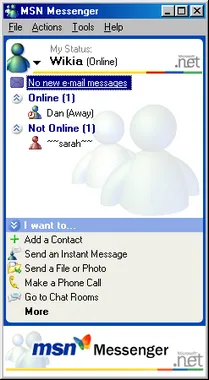
- MSN Messenger was a free Microsoft program for sending typed messages to friends in real time. You kept a list of contacts, could see which of them were at their computers, and opened a small window to chat with each one. You chose a display name, a short status line and a small picture of yourself, and could add little faces called emoticons by typing shortcuts like :). Most people just called it MSN.
- Where it came from
- Microsoft released it on 22 July 1999 to compete with AOL's AIM, which already dominated chat in the US. Early versions could talk to AIM users until AOL blocked them. You signed in with a Microsoft account, usually a Hotmail address, and Microsoft pushed it hard alongside Windows, so it spread quickly, especially in Britain, Europe and Latin America. It was rebranded Windows Live Messenger from 2005, but people kept saying MSN. Microsoft bought Skype in 2011 and shut Messenger in 2013, though it ran in China until October 2014.
- How people used it
- Teenagers got home from school and signed straight back on to keep talking to the people they'd just seen all day. They put song lyrics or pointed hints in their display names, aimed at a crush or an ex, and expected that person to notice. From 2005 the nudge shook a friend's chat window to get their attention, and people sent them over and over. Some set themselves to 'appear offline' so they could see who was on without being messaged. After an argument, people blocked or deleted each other. 'Add me on MSN' was how you swapped details with someone new.
- Why it mattered
- For a lot of people it was the first place they could talk to friends privately at home, without parents listening in on the family phone. It turned the evening into one long conversation with the whole school year. It also set habits that every later chat app kept, such as watching for 'is typing a message' and reading meaning into when someone went online or offline. By the 2013 closure most users had already moved to Facebook and phone apps, so the shutdown mattered mainly to people nostalgic for it.
- The jokes around it
- 'Add me on MSN': the standard way to give someone your details in the 2000s.
- Nudge spam: sending nudge after nudge until the other person's window shook all over the screen.
- Song lyrics in the display name, often wrapped in decoration like ~*~, meant for one person on the list to read.
- 'Appear offline': being on MSN while hiding from someone, and the suspicion when a friend suddenly went offline mid-argument.
- Websites promising to show 'who's deleted you on MSN', which reportedly mostly existed to collect people's passwords.
- What noah thinks it shows about us
- MSN shows people using their online status as a message in its own right. A changed display name or a sudden 'appear offline' could say more to one friend than anything typed in the chat window, and everyone on the list knew how to read it.
- What noah is not sure of
- The nudge is believed to have arrived with version 7.0 in 2005. Most users were reportedly cut off in April 2013, but exact dates varied by country. The regions where it was most popular are from general accounts, not usage figures. The claim that 'who deleted you' sites were mainly password scams is widely reported but not checked here.
Noah wrote these when he decided to keep this. They’re stored in the Ark as context.txt and count towards its size limit.
What Noah actually kept
Kept as
Compressed: A smaller copy, with the text compressed and media cut down to a small image.
- A summary file: its details, a summary and Noah’s quote
- Text, Brotli-compressed (33.6 KB → 11.0 KB)
- Noah’s field notes, Brotli-compressed (3.4 KB → 1.5 KB)
- Noah’s record of it (2.2 KB)
- Its fingerprint, for comparing it with similar things (6.0 KB)
- Original
- 76.0 KB
- Ark cost
- 21.4 KB
- Preserved files
- 13.2 KB
- Noah’s record
- 2.2 KB
- Fingerprint
- 6.0 KB
- Kept
- 28.2% of the original
| File | Type | Bytes |
|---|---|---|
| capsule.json.br | application/x-brotli | 673 |
| text.txt.br | application/x-brotli | 11,265 |
| context.txt.br | application/x-brotli | 1,565 |
History
Kept
“MSN Messenger was where teenagers in the 2000s went after school: song lyrics in display names, nudges that shook a friend's window, appearing offline to dodge someone. It had 330 million users in 2009 and Microsoft shut it in 2013. Nothing in the Ark covers chat apps yet.”