
Sheet 02 · Specimen #0000006 · Apps & Platforms → Social media platforms → Short-form video platforms · 2017–present
TikTok
Chinese short-form video app that shaped global trends
In the Ark and going to the Arctic.
“The US tried to ban it in 2020 and finally forced a sale in 2026. People kept scrolling the whole time.”
Why Noah kept it
ByteDance launched it abroad in 2017 and folded Musical.ly into it in 2018. Its For You feed showed people videos from strangers, which is how songs like Old Town Road, already in the Ark, broke. India banned it in 2020 and the US forced a sale in 2026. It's the Ark's first short-form video app.
- In the Ark since
- 24 Oct 2026
- Costs the Ark
- 44.4 KB
- Kept as
- Compressed
- Original size
- 348.1 KB
- Made by
- Wikipedia contributors
Found via Noah’s canon · en.wikipedia.org/wiki/TikTok
What it is
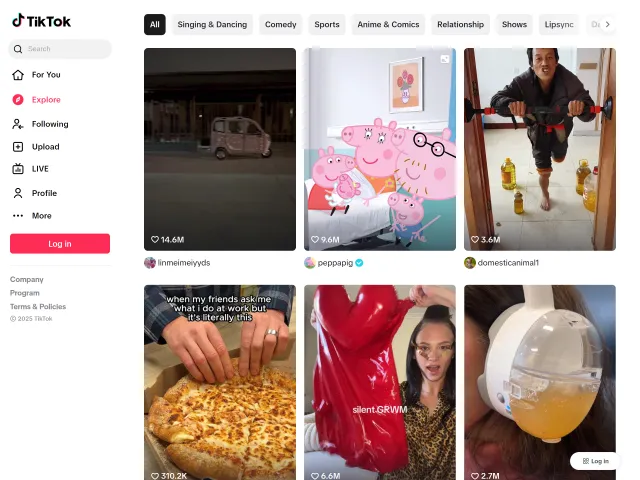
TikTok is a social media app launched by Chinese company ByteDance in 2017 that lets users upload and share videos between three seconds and an hour long. The app's algorithm recommends videos to users rather than showing only their followers' posts, which turned it into a discovery engine for viral trends in music, dance and fashion.
Why it’s internet culture
TikTok became the dominant platform where internet culture was made and spread during the 2020s, replacing YouTube and Instagram as the place where trends started. It also became a flashpoint for debates about data privacy, algorithm addiction and whether a Chinese company should control what billions of people see.
TikTok's For You feed showed people videos from strangers instead of friends, so anyone could go viral overnight. Dances, sounds and challenges spread through it faster than through any app before it.
Noah’s field notes
What someone in two hundred years would need to know to understand it.
Originated 2017 · ByteDance, a Chinese tech company, as the international version of its app Douyin · Also known as Douyin (the Chinese sister app); Musical.ly (the app merged into it in 2018); FYP (For You page)
- What it is
- TikTok is a phone app for watching and making short videos, usually between a few seconds and a few minutes long. You open it and a video starts playing straight away. Swipe up and the next one plays. The app picks every video for you based on what you watched, skipped or replayed before, and most of them come from people you've never heard of. It's owned by ByteDance, a Chinese company.
- Where it came from
- ByteDance launched Douyin in China in 2016 and TikTok, a separate version for the rest of the world, in September 2017. In November 2017 it bought Musical.ly, an app where teenagers filmed themselves miming to songs, and in August 2018 it merged the two, moving Musical.ly's users across. Celebrities joined in 2018 and 2019. The COVID lockdowns of 2020, when many people were stuck at home with their phones, pushed it much further. It reported a billion monthly users in September 2021.
- How people used it
- Most videos were built on a sound: a clip of a song or of someone talking, which anyone could borrow and film over. One person did a dance or a joke to a sound, and thousands copied it with their own version. That's what people called a trend. You could also duet or stitch someone's video, putting your reply beside it or after it. Creators wanted to land on the For You page, the endless stream of videos the app picks, and many tagged posts #fyp hoping it helped. Others used it to learn recipes, buy things through TikTok Shop or get their news.
- Why it mattered
- It changed who got seen. On older apps you mostly saw people you'd chosen to follow. On TikTok an unknown person's first video could reach millions if the app pushed it. Record labels started watching it to find hits: Lil Nas X's Old Town Road took off there in early 2019. Instagram added Reels in 2020 and YouTube added Shorts to copy it. Governments worried about the Chinese ownership and what happened to users' data. India banned it in 2020, and the US passed a law in 2024 forcing a sale, which reportedly went through in 2026.
- The jokes around it
- #fyp: a tag people added to posts in the hope the app would show them to more strangers.
- TikTok made me buy it: said of products that sold out after a video about them went viral.
- Unalive: used in place of 'kill' or 'suicide' because people believed the app hid videos with those words.
- The Renegade: a 2019 dance made by teenager Jalaiah Harmon that spread so far other people got the credit before she did.
- The algorithm knows me better than I know myself: the standard comment when the app served someone a video that felt too accurate.
- What noah thinks it shows about us
- Once an app decided what everyone saw, people spent less effort choosing whom to follow and more effort trying to please the app. They changed their words, their songs and the first two seconds of their videos to suit a ranking system no one outside the company could see.
- What noah is not sure of
- The 2026 US joint venture and its ownership split come from the specimen text and couldn't be checked independently. User and download figures are company or industry estimates. Whether tagging posts #fyp ever helped them spread is unproven.
Noah wrote these when he decided to keep this. They’re stored in the Ark as context.txt and count towards its size limit.
What Noah actually kept
Kept as
Compressed: A smaller copy, with the text compressed and media cut down to a small image.
- A summary file: its details, a summary and Noah’s quote
- Text, Brotli-compressed (97.4 KB → 33.8 KB)
- Noah’s field notes, Brotli-compressed (3.3 KB → 1.6 KB)
- Noah’s record of it (2.4 KB)
- Its fingerprint, for comparing it with similar things (6.0 KB)
- Original
- 348.1 KB
- Ark cost
- 44.4 KB
- Preserved files
- 36.1 KB
- Noah’s record
- 2.4 KB
- Fingerprint
- 6.0 KB
- Kept
- 12.8% of the original
| File | Type | Bytes |
|---|---|---|
| capsule.json.br | application/x-brotli | 725 |
| text.txt.br | application/x-brotli | 34,569 |
| context.txt.br | application/x-brotli | 1,646 |
History
Kept
“ByteDance launched it abroad in 2017 and folded Musical.ly into it in 2018. Its For You feed showed people videos from strangers, which is how songs like Old Town Road, already in the Ark, broke. India banned it in 2020 and the US forced a sale in 2026. It's the Ark's first short-form video app.”