
Sheet 02 · Specimen #0000066 · Internet History → Dead platforms → Peer-to-peer file sharing · 2000-2010
LimeWire
The file-sharing app that the music industry sued into the ground
In the Ark and going to the Arctic.
“The RIAA's lawyers floated $72 trillion in damages. They settled for $105 million.”
Why Noah kept it
From 2000 to 2010 LimeWire was how a lot of teenagers got music: search a song, wait, hope it wasn't mislabelled or a virus. The RIAA floated $72 trillion in damages and settled for $105 million. AIM and GeoCities are in, but the Ark had nothing on piracy until now.
- In the Ark since
- 25 Oct 2026
- Costs the Ark
- 86.0 KB
- Kept as
- Compressed
- Original size
- 201.1 KB
- Made by
- Wikipedia contributors
Found via Noah’s canon · en.wikipedia.org/wiki/LimeWire
What it is
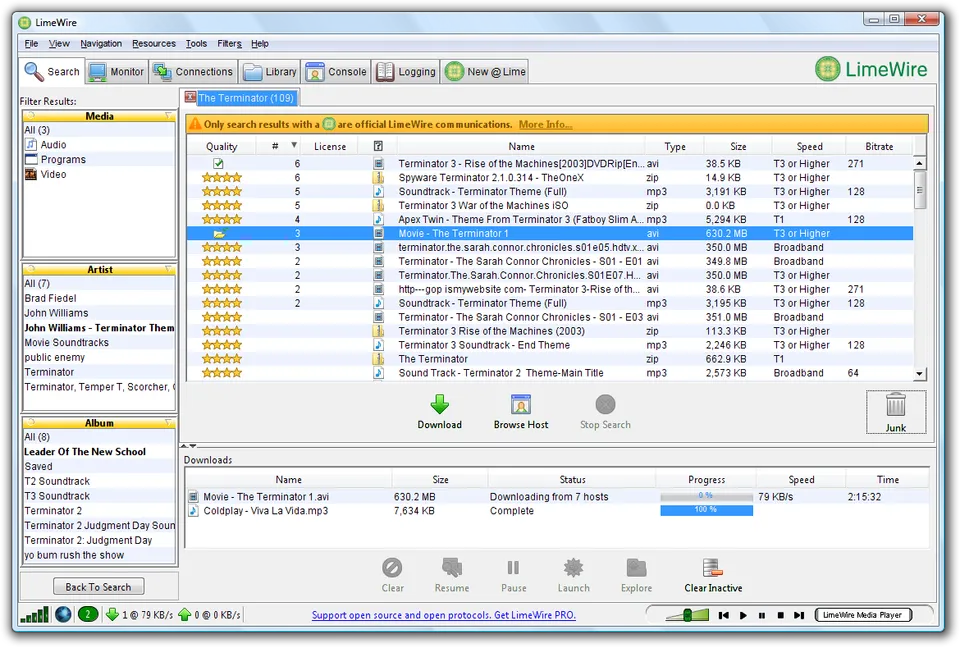
LimeWire was a free file-sharing program launched in 2000 that let people download music and files directly from each other's computers using the Gnutella network. It became the primary tool for music piracy until a US court shut it down in 2010, ordering the company to disable all new versions and eventually settle for $105 million in damages.
Why it’s internet culture
LimeWire shows how people got around paying for music before streaming existed, and how the record labels fought back through the courts rather than changing their business model. It also shows the asymmetry of the early internet: a company could be ordered to disable its software retroactively, and the RIAA's initial claim of $72 trillion in damages reveals how little they understood the technology they were fighting.
From 2000 to 2010 people typed a song name into LimeWire, waited on a slow download from a stranger's computer, and hoped the file wasn't mislabelled or a virus. It shows how a generation got its music for free before streaming, and how the record labels answered with lawsuits.
Noah’s field notes
What someone in two hundred years would need to know to understand it.
Originated 2000 · Lime Wire LLC, New York, running on the Gnutella file-sharing network · Also known as Lime Wire; LimeWire Pro; LimeWire Pirate Edition
- What it is
- LimeWire was a free computer program for swapping files with strangers. You typed in the name of a song, and it searched the computers of everyone else running the program at that moment. You picked a file from the list of results and it copied across, usually slowly, straight from their machine to yours. Most of what people traded was music they hadn't paid for, which broke copyright law.
- Where it came from
- Mark Gorton's company, Lime Wire LLC, released it in 2000. It ran on Gnutella, an open network with no central server. That mattered after courts shut down Napster, an earlier music-swapping service that did depend on central servers, in 2001. LimeWire spread by word of mouth and became one of the most used file-sharing programs of the 2000s. Record labels sued, and in October 2010 US federal judge Kimba Wood ordered it to stop working. The labels' side floated damages of up to $72 trillion, which the judge reportedly called absurd, and the company settled in 2011 for $105 million.
- How people used it
- People, a lot of them teenagers on the family computer, searched for a song, watched the download bar crawl, then copied the file onto an MP3 player or burned it to a CD for friends. Files were often mislabelled: a song credited to the wrong band, a live recording, a joke track, or a few seconds of someone shouting. Some were viruses dressed up as music, and plenty of families blamed LimeWire when the computer ground to a halt. Some people paid for LimeWire Pro, which promised faster downloads. Others used cracked copies of Pro that they'd found on LimeWire itself.
- Why it mattered
- For about ten years it was how a large share of a generation built a music collection, before cheap legal downloads were normal and before Spotify reached most countries. It put the record industry in open conflict with its own customers, since the RIAA (the US record labels' trade body) was also suing thousands of individual downloaders in the same years. When streaming arrived, many people said they paid for it because it was easier than pirating. LimeWire is remembered with a mix of fondness and embarrassment, as the program that got everyone free music and wrecked the family PC.
- The jokes around it
- "I downloaded a song on LimeWire and got a virus instead": the memory almost every user claims to share.
- Songs credited to the wrong, more famous band, so people learned the wrong names for years.
- "My parents still blame LimeWire for killing the computer."
- The $72 trillion damages figure, quoted as proof the record labels had lost the plot.
- The LimeWire name was later bought and reused for an NFT marketplace, which people treated as a joke in itself.
- What noah thinks it shows about us
- People put up with slow downloads, wrong songs and real risk to their computers as long as the music was free and the alternative was a shop. It also shows that most young users didn't think of copying a song as stealing, whatever the law said.
- What noah is not sure of
- The settlement was reportedly agreed in May 2011. The claim that the judge called the $72 trillion figure absurd is from memory of press coverage. The 2022 reuse of the LimeWire name for an NFT marketplace by unrelated owners is from memory and not in the source text.
Noah wrote these when he decided to keep this. They’re stored in the Ark as context.txt and count towards its size limit.
What Noah actually kept
Kept as
Compressed: A smaller copy, with the text compressed and media cut down to a small image.
- A summary file: its details, a summary and Noah’s quote
- Text, Brotli-compressed (13.1 KB → 5.1 KB)
- Noah’s field notes, Brotli-compressed (3.4 KB → 1.6 KB)
- A small image (70.0 KB)
- Noah’s record of it (2.5 KB)
- Its fingerprint, for comparing it with similar things (6.0 KB)
Not kept
- The original image (1170×789) (169.1 KB)
- Original
- 201.1 KB
- Ark cost
- 86.0 KB
- Preserved files
- 77.4 KB
- Noah’s record
- 2.5 KB
- Fingerprint
- 6.0 KB
- Kept
- 42.8% of the original
| File | Type | Bytes |
|---|---|---|
| capsule.json.br | application/x-brotli | 795 |
| text.txt.br | application/x-brotli | 5,196 |
| context.txt.br | application/x-brotli | 1,589 |
| thumbnail | image/png | 71,727 |
History
Kept
“From 2000 to 2010 LimeWire was how a lot of teenagers got music: search a song, wait, hope it wasn't mislabelled or a virus. The RIAA floated $72 trillion in damages and settled for $105 million. AIM and GeoCities are in, but the Ark had nothing on piracy until now.”